Daily Scrum: The Fourth Question

Let’s face it – Daily Scrum happens to be boring meeting sometimes. In the long run it may turn out to be tiresome routine, even for a team that understands its importance.

To make our meetings at SoftwareMill more interesting, we have implemented the idea of The Fourth Question, which I want to share here.

What is the question today?

Basically, apart from the usual three questions (Done yesterday. Plan for today. Blockers.) each member of the team answers additional one. What is the Fourth Question? Well, that is a good question 🙂

The question is announced by the ScrumMaster, who is free to come up with any question they like. This may be something connected with the project or personal.

Each day the question is different. Since in our team the person that leads the meetings changes every week, each member of the team has their chance to ask questions.

Examples

Here is a list of various questions that appeared on our Daily Scrums:

  • How are you feeling today?
  • Which day is the most effective day for you?
  • How useful this meeting is for you?
  • What have you learned recently?
  • What is your favorite shortcut in our IDE?
  • What should we do with people coming late for Scrum?
  • What did you have for breakfast?
  • What is your favorite movie?
  • What board game did you play recently?
  • What gadget have you bought or received recently?
  • What sport did you practise recently? (And when it was? ;))
  • Ideas to spend time with a child in winter.

Since we are a remote team, we have also asked each other questions like:

  • What type of the office chair have you got?
  • What have you got on your desk that is not connected with your work?
  • Do you listen to the music when you work?
  • How are you making notes?

(Authors: The Whole Team)

Areas of application

This technique

  • is useful for coaching
  • stimulates knowledge sharing
  • will help team members to get to know each other
  • will definitely introduce some fun and diversity 🙂

Guidelines

Of course having one more question might lead to the longer meetings, but with a little bit of discipline it is still possible to keep 15 minutes limit (If this gets difficult you can always ask “What can we do to keep the limit?” ;)).

It is a good practice to announce the question some time before the Daily Scrum. People will then come with the answers ready.

We favor simple questions that can be answered in one sentence.

Give it a try

If you like this idea, do not hesitate and introduce it on your next Daily Scrum meeting. Let me know how it worked in your team and what were your questions.

Have fun with the Fourth Question!

-Paweł

PS See also Łukasz’s post about this idea.

Agile Central Europe 2011 Impressions

Last week I had a pleasure of attending the Agile Central Europe 2011 conference and presenting my talk about working remotely there.

I felt that this conference would be special from the moment I received an invitation to join the open discussion on the way the event should be organized. What a fantastic idea!

The speakers, presentations and the way that the whole ACE! 2011 was organized were more than awesome. Here are the talks I liked most.

Paweł Brodziński – “Kanban: Improvements when you don’t look for them”

The presentation agenda displayed on a Kanban board served as a sort of an introduction (happening in the background) for those not familiar with the Kanban approach (including me). This way Paweł allowed himself more time to go beyond just the basics.

I especially liked the way Kanban shortens the feature lifecycle. Working in 2-week Scrum iterations I sometimes feel that there are too many various features being developed at the same time. Kanban helps to tackle this problem with it’s “Limit Work In Progress” approach.

Andrea Provaglio – Overcoming Self-organization Blocks

Probably the most psychological presentation at ACE! I really enjoyed the demonstration of rowing against the tide as well as the exercises led by Andrea during the Open Space.

By the way Andrea’s Open Space session showed one of the Open Space Principles in action. The session was so popular that the whole group decided to move to another room in order to have more space.Whatever happens is the only thing that could have.”

Marc Löffler – Kaboom – Blow up your watermelon

Marc‘s presentation was both entertaining and enlightening. The watermelon is indeed a perfect metaphor of what  happens pretty often in our industry when it comes to reporting to the management. What is red inside looks more like green when it reaches the top executives.

Closing Keynote – Jurgen Appelo

Both the insight and the way Jurgen presented the content were awesome. He definitely set a new standard for closing keynotes by quoting every single conference speaker in his talk.

I must admit I was impressed with how great this event was. Congratulations to Paul Klipp and all people involved in organizing the ACE! 2011 conference.

-Paweł

PS I am still thinking about the name for the software development method described by Maria Diaconu and Alexandru Bolboacă in their talk “Yes, You Can Deploy Every Two Days!”.

Seam-Guice is now part of Seam

Google Guice support for Seam is now part of the Seam distribution!

It is available since the 2.1.2 release of Seam, as a part of the IoC module, but if you happen to need it, the best choice is to grab the latest 2.2.0.GA version which includes a fix for the disinjection issue.

Disinjection

The problem with disinjection was that the implementation injected values to the fields annotated with @Inject, but did not clear those values after the method call. The disinjection step here is required for exactly the same reason that Seam itself performs it on @In- and @Out-jected fields – to prevent a long-scoped Seam component from holding a reference to a (possibly short-living) Guice component.

Also, the presence of disinjection allows you to @Inject non-serializable properties into serializable components without having to worry about making those properties transient.

Configuration and Docs

The configuration did not change, except for one detail, which is the “guice” namespace URL declaration in the components.xml file:

All components are now in the org.jboss.seam.ioc.guice package.

If you feel like checking the latest documentation of the Seam-Guice module, here is the link:
http://docs.jboss.com/seam/2.2.0.GA/reference/en-US/html/guice.html.

Thanks to Dan Allen who reviewed my code and spotted the disinjection issue.

-Pawel

Seam Talk at GeeCON


I am speaking at the GeeCON conference in Cracow this Friday.

The presentation is called “Seam for Spring Developers” and will be a fast-track introduction to Seam and a “Seamish” way of thinking for those already experienced with other Java web frameworks, like Spring.

If you are around, make sure to choose Room 5 at 12.15 😉

See you there.

-Pawel

Update: I’ve uploaded the presentation slides.

Seam Exam (beta) @ JavaBlackBelt

Together with Matthias Merz we created Seam – Basic Exam at JavaBlackBelt.

It verifies general understanding of the Seam 2.0 concepts, required to implement a simple Seam application.

The exam is now in the beta stage, which means it is available publicly and you can take the (beta) exam, which does not count for your belt progress. It will be released as soon as we collect enough stable questions in each category.

Like all exams available at JavaBlackBelt, it is free.

You are welcome to contribute your own questions and improve or rate existing ones.

Exam page

JavaBlackBelt Seam Exam

Cheers,
-Pawel

JBoss.org Project Statistics

The JBoss.org Team is pleased to release JBoss.org Statistics, available at stats.jboss.org. We provide JIRA and Subversion statistics for projects hosted at JBoss.org.

JBoss.org Statistics are powered by Kosmos, created by Aron Gombas. They run on JBoss Portal.

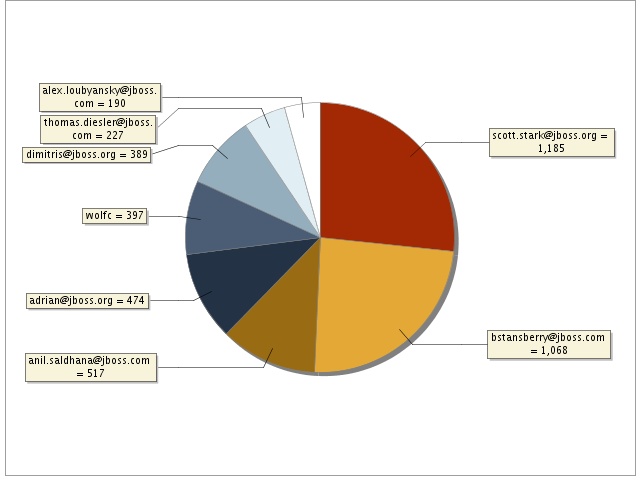
They come with a couple of interesting charts, which let you easily find out the most active commiters of the JBoss AS project:

or how new projects (like Envers) grow in size:

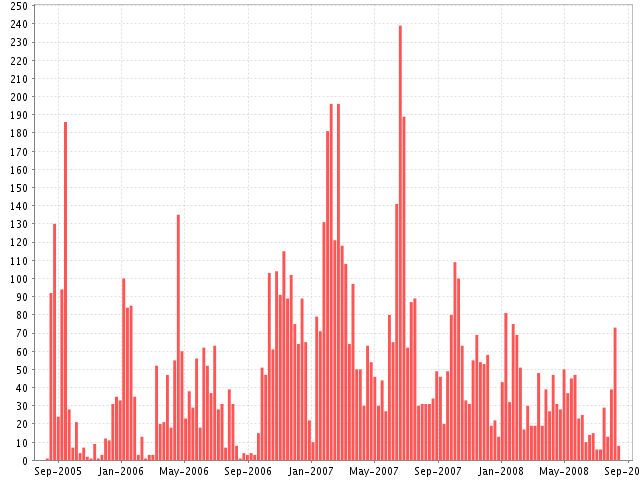
Now, looking at the following chart, guess when the Seam Freamework releases occurred:

Well, 1.0 beta1 was out in September 2005, beta2 in February 2006, 1.0 GA in June. And so on 🙂 Here is the full list.

On the “Most Active Files” diagrams I quickly discovered that usually the most frequently changed files are… Maven files 🙂

JBoss Microcontainer - Most Active Files

Needless to say, you will find more at stats.jboss.org.

Enjoy,
-Pawel

Guicy Seam

Introducing @Guice annotation

You may already have heard about Seam being a “deep integration framework” and Google Guice providing lightweight dependency injection. The news is that you can now easily use Seam together with Guice.

The WebBeans specification is built upon concepts from both of those frameworks. Since Seam provides Spring support in the IoC module, why not to integrate Guice as well? Thinking this way I have implemented Guice support for Seam.

Quick Howto

The rule is fairly simple – if you want to use Guice injection in your Seam component, annotate it with the @Guice annotation.


@Name("myGuicyComponent")
@Guice
public class MyGuicyComponent
{
@Inject MyObject myObject
}

view raw

gistfile1.java

hosted with ❤ by GitHub

For all Seam components annotated with the @Guice annotation, Guice injection will be performed automatically.

Great, but wait… which Guice injector will be used? Well, the one you provide. Just edit components.xml:


<components
xmlns="http://jboss.com/products/seam/components&quot;
xmlns:guice="http://jboss.org/jbosslabs/seam-guice"&gt;
<guice:init injector="#{myGuiceInjector}/>
</components>

view raw

gistfile1.xml

hosted with ❤ by GitHub

myGuiceInjector should be a Seam component that implements the Injector interface.

You may want to create it from a list of modules:


<guice:injector name="myGuiceInjector">
<guice:modules>
<value>com.example.guice.GuiceModule1</value>
<value>com.example.guice.GuiceModule2</value>
</guice:modules>
</guice:injector>

view raw

gistfile1.xml

hosted with ❤ by GitHub

Of course you can also use an injector that is already used in other, possibly non-Seam, parts of you application. That was one of the reasons I implemented this integration – to tie other parts of an application that used Guice together with Seam.

To enable Seam and Guice integration, add seam-guice.jar library to your application. Do not forget to put guice-1.0.jar in as well 😉

Give it a try!

I have included more information on the wiki page. You can download seam-guice library and browse the source code. It is implemented as a simple interceptor. Let me know if you find a bug or a place for improvement.

If you like this solution, you can vote to make it part of the Seam project. You may also want to have a look at Guice and plain JSF integration and the Guice extension to JBoss Microcontainer.

Many thanks to Tomek, who introduced Guice to me, Kamil, for feedback and Adam, for encouraging me to blog about it 😉

-Paweł